By Paul DiSclafani
John Sepe’s father was a musician. He played piano and sang in the church choir.
“He was a really good piano player,” John said, “and my whole life, I wanted to play music.”
Just not the piano.
“I wanted to play a loud instrument,” he laughed. “I wanted to play in a band.”
So, when joining the school band in the fourth grade, he selected the trumpet and never looked back. His ability to play the instrument seemed to come naturally, and he never needed his parents to hound him about practicing.
The Newark, New Jersey, native’s musical journey with the trumpet became not only a lifelong passion but also a career. He played in bands as a kid, taught music as a band director, conducted orchestras, and played in the pits for live stage shows. The music major from Montclair State even majored in music theory and composition, writing his own music.
He got his first paying gig at a New Jersey Italian Club, Buccinese’s, when he was 13. “It was an old man’s club, filled with cigar smoke,” he recalled. “We made five bucks each. I remember playing the song, ‘Tequila.’”
Even the Army recognized his musical talents, and he performed with the Army Band from 1967 to 1973. John’s trumpet was the only sound you would hear playing “Taps” at Fort Bragg in North Carolina. They performed so well together that, after being discharged, they played professionally for several years. “We played lots of Blood, Sweat and Tears, Herb Alpert, and Chicago,” John noted.
John became the band director at several New Jersey schools, including Rockaway Boro in Morris County, where he met his wife, Angela, who was teaching there. They initially settled in Denville, New Jersey, but spent the past 30 years in Sussex County before leaving the Garden State and relocating to On Top of the World in 2022.
His years as a band director allowed him to take the students all over the world to perform. “I’ve seen more of Europe than I have here in the States,” he said, recalling performances in Austria, Germany, and China. “We even performed on the Great Wall of China.”
In 1998, he began conducting the Sussex County Youth Orchestra. “You have to learn everything yourself,” he said of the daunting task of conducting an orchestra. “I’ve always been interested in every instrument. I started writing music for small orchestras and then for large orchestras while in college.”
When he finally had the chance to conduct his own piece, “Evolutions,” he felt it resonated with the audience, and they genuinely enjoyed it. “It’s one thing to have the piece in your head,” he explained, “but when you actually hear it performed, you’re never happy with it. Now there are things you need to adjust to make it better.”
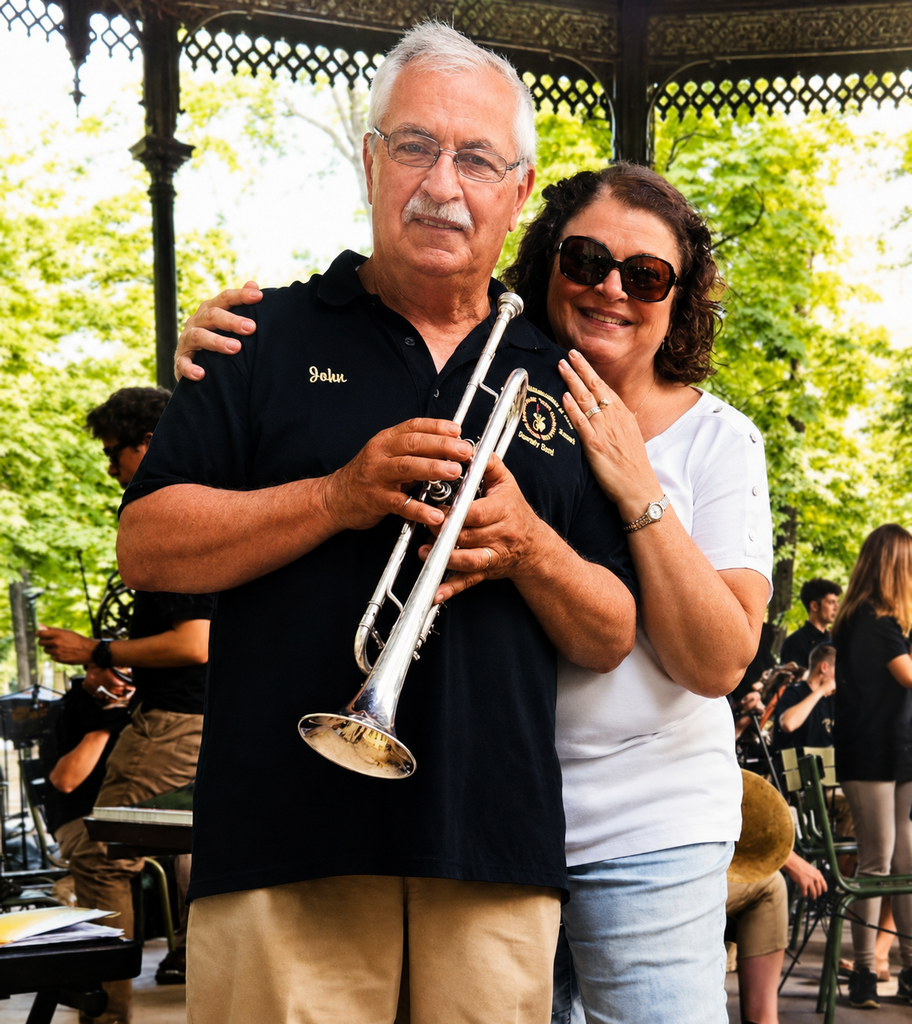
Musicians listen to music differently than the average music lover. John still has plenty of music in his private collection, which mostly consists of classical music and what he calls the post-romantic period (1900-1950). “That era has a very wide emotional range, from sad to happy,” he said. “I played pop music all my life, but that’s not real music to me. People listen to pop music for the lyrics, and that’s okay. That’s why it’s popular. I want to be challenged when I listen to music.”
Even though John has made a life as a musician, don’t expect to see him on stage at the Town Commons on a Saturday evening, performing show tunes from “Fiddler on the Roof” or “Les Misérables.” Instead, you’ll find him piloting his radio-controlled airplane or spending time building sets in his garage for his model railroad, two hobbies he brought with him from New Jersey. His father even worked for Lionel Trains.
“I’ve been playing, performing, conducting, and teaching music my entire life,” he said. “I’m done practicing. Now I’d rather smoke a cigar.”
From performing onstage for the first time in a room full of cigar smoke to enjoying a Padron or two himself, John Sepe’s musical journey has come full circle.